
Have you ever filmed a video that looked professional on your phone screen, but when you uploaded it to YouTube, it looked muddy, orange, and amateurish? The culprit is often the lightbulb in your ceiling fixture.
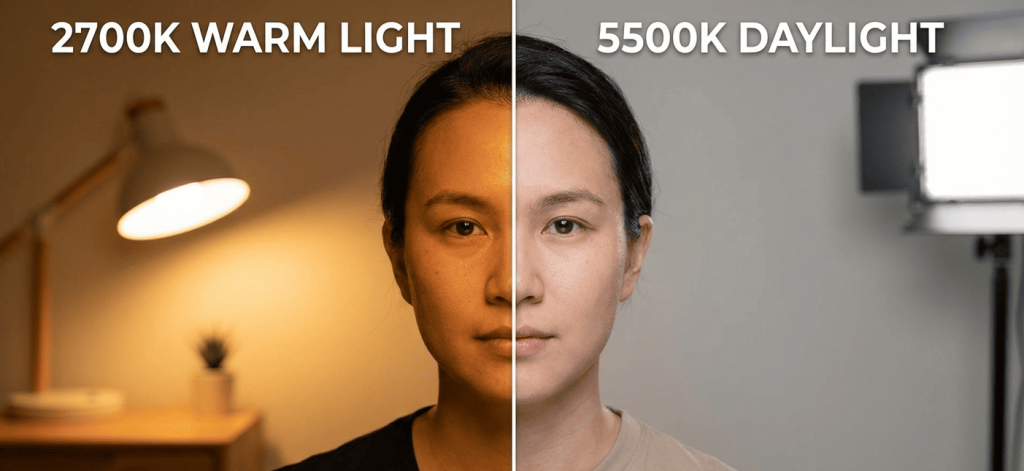
Standard household lights are typically tuned to 2700K (Kelvin), a warm, yellowish color designed to be relaxing. While nice for a living room, it’s terrible for video. Understanding the physics of **color temperature for video** is the first step to looking professional on camera.
What is White Balance and Why Your Camera “Lies”
Your eyes are amazing at adjusting to different light sources. A piece of white paper looks white to you whether you’re standing outside at noon or inside under a warm lamp. Your camera, however, is not that smart.
It has to guess what “white” is. If you have mixed lighting—for example, blue light coming in from a window and yellow light from a desk lamp—your camera’s automatic white balance gets confused. The result is weird skin tones that can make you look sick, tired, or unnatural.
The Golden Standard: 5500K (Daylight)
In the world of video and photography, 5500K is the reference standard. It mimics the color of bright midday sun. Why is this important?
- Accurate Skin Tones: This neutral white light renders human skin tones most accurately. It doesn’t add a yellow cast (which can emphasize wrinkles and blemishes) or a blue cast (which looks cold and lifeless).
- Pure Spectrum: Skytex 5500K lamps, both CFL and LED, are designed with a high CRI (Color Rendering Index) of 90+. This means they contain a full spectrum of colors, allowing your camera to capture richer, more vibrant, and “cleaner” footage.
When Should You Use Warm Light (2700K-3200K)?
Warm light isn’t bad; it just has a different psychological effect. It feels cozy, intimate, and safe. You might choose a warmer light for a late-night “just chatting” stream, a relaxing ASMR video, or an evening vlog where you want to create a specific mood.
This is where **Bi-Color** lights shine. Skytex Bi-Color LED panels allow you to adjust the temperature from warm (3200K) to cool daylight (5600K) with the turn of a dial. You can change the entire mood of your set in seconds without changing bulbs.
Final Thoughts
Don’t let bad lighting ruin good content. For most video applications, stick to **daylight balanced bulbs** (5500K) for a clean, professional, and flattering look. If you need flexibility for different moods, invest in a bi-color LED solution that gives you the best of both worlds.